
Sensex Sinks 1,236 Points, ₹7 Lakh Crore Wiped Out: What Triggered Dalal Street’s Sharp Selloff?
- Bestvantage Team
- Feb 20
- 5 min read
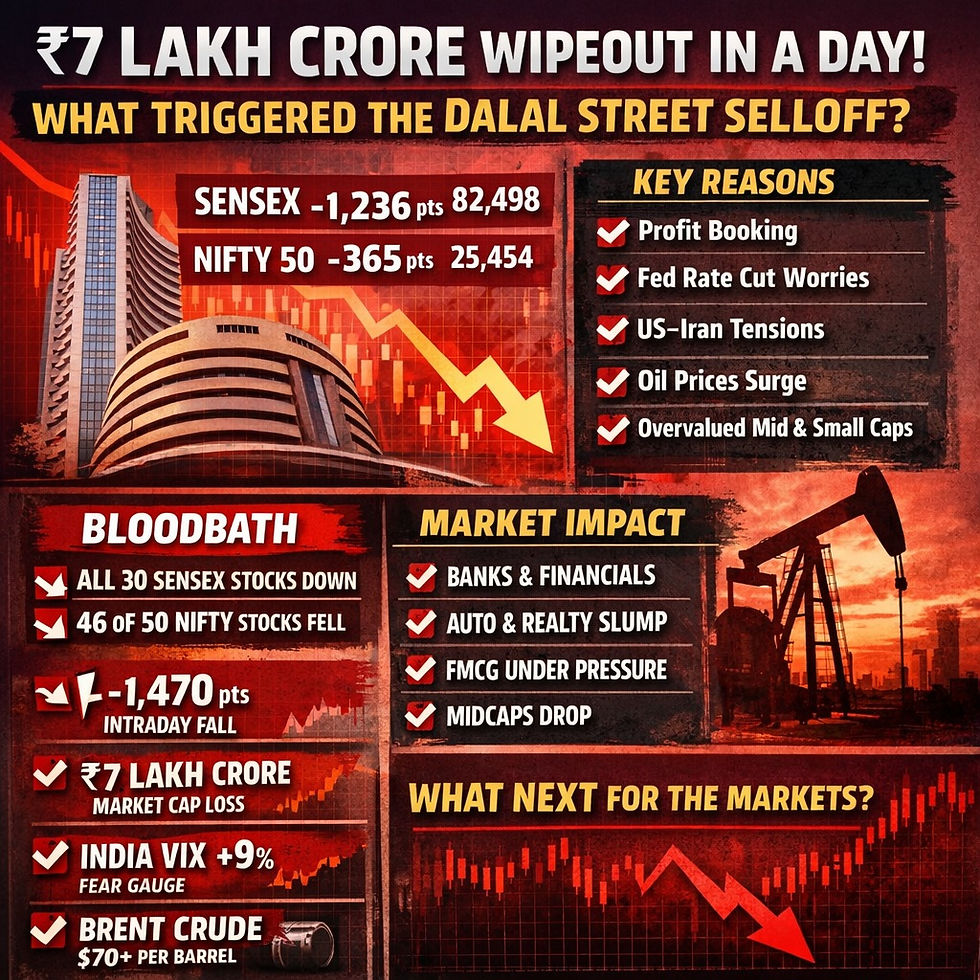
Indian equities witnessed a sharp and broad-based correction on February 19, with the BSE Sensex plunging 1,236 points to close at 82,498.14 and the Nifty 50 falling 365 points to settle at 25,454.35. Intraday losses were even steeper, with the Sensex down as much as 1,470 points and the Nifty breaching 25,388.75. Nearly ₹7 lakh crore in investor wealth was erased as total market capitalisation of BSE-listed firms dropped from ₹472 lakh crore to about ₹465 lakh crore. Volatility surged, crude oil jumped above $70 per barrel, and market breadth turned decisively negative.
Let’s take a look at the chaos and make some sense of it.
Market Snapshot: The Core Numbers
Indicator | Latest Reading | Change |
Sensex | 82,498.14 | -1,236 points (-1.48%) |
Nifty 50 | 25,454.35 | -365 points (-1.41%) |
Intraday Sensex Low | 82,264 | -1,470 points approx |
Intraday Nifty Low | 25,388.75 | Breached 25,400 |
Market Cap | ₹465 lakh crore | ₹7 lakh crore wiped out |
India VIX | Up over 9% | Volatility spike |
Nifty Bank | 60,740 | -811 points |
Brent Crude | Above $70 | Up over 4% prior session |
WTI Crude | Around $65.4 | Up 4.6% prior session |
1. Broad-Based Selling Across Indices
The correction was not confined to a single sector or stock. All 30 Sensex constituents ended in the red. On the Nifty 50, 46 out of 50 stocks closed lower. The NSE advance-decline ratio stood at 1:3, highlighting overwhelming selling pressure. Mid and small caps also weakened. The Nifty MidCap index slipped around 1.7 percent, while the SmallCap index declined close to 1.5 percent. The BSE 150 MidCap Index fell 1.54 percent and the BSE 250 SmallCap Index dropped 1.16 percent. Such synchronised weakness across market capitalisations signals risk-off behaviour rather than isolated stock-specific reactions.
2. Profit Booking After Three-Day Rally
Markets had rallied for three consecutive sessions prior to the selloff. The Sensex and Nifty had extended gains amid optimism around domestic macro stability and earnings.
However, with major triggers such as the Union Budget, RBI policy announcements, and Q3 earnings season already priced in, traders opted to lock in gains. Analysts described the fall as tactical profit booking rather than structural deterioration. Intraday unwinding of leveraged positions amplified the decline once key support levels were breached, accelerating automated selling.
3. US Federal Reserve’s Mixed Signals
Global sentiment weakened after minutes from the US Federal Reserve’s January meeting revealed a split among policymakers. Some members expressed openness to rate cuts if inflation cools further, while others indicated readiness to tighten policy again if price pressures persist.
For emerging markets like India, this uncertainty is critical. Any delay in rate cuts or surprise tightening could strengthen the US dollar and reduce foreign portfolio inflows. This comes at a sensitive time, as FII flows had just resumed in February after seven consecutive months of cash market outflows. A stronger dollar also typically pressures the Indian rupee, adding another layer of caution for foreign investors.
4. Surge in Crude Oil Prices
Oil prices played a significant role in denting sentiment. Brent crude surged over 4 percent to above $70 per barrel, while WTI crude jumped 4.6 percent to around $65.4. Brent remained above the $70 mark during Thursday’s trade.
India imports over 80 percent of its crude oil requirements. Elevated oil prices widen the current account deficit, pressure the rupee, and raise inflation concerns. Higher crude also increases input costs across sectors including transportation, aviation, paint, cement, and FMCG.
The spike in oil prices added to inflation worries and reduced expectations of near-term monetary easing globally.
5. Escalating US-Iran Geopolitical Tensions
Reports of potential US military action against Iran heightened geopolitical risk. Developments included increased naval presence and warnings over Iranian airspace. Markets tend to react sharply to Middle East tensions because of the region’s importance in global energy supply chains.
Investors feared potential disruptions in the Strait of Hormuz, through which a significant portion of global oil supply passes. Even the possibility of prolonged conflict pushed traders into risk reduction mode, particularly ahead of the weekend.
Geopolitical uncertainty typically leads to a flight to safety, benefiting gold and bonds while weighing on equities.
6. Heavyweight Stocks Under Pressure
Index heavyweights bore the brunt of the selloff. Stocks such as Reliance Industries, HDFC Bank, ICICI Bank, Kotak Mahindra Bank, and Larsen and Toubro contributed significantly to index declines due to their high weightage.
Even defensive names like Hindustan Unilever and ITC saw weakness. The fall in large-cap stocks amplified benchmark declines because these companies collectively account for a substantial portion of index calculation. Sector wise, Realty, Auto, Financial Services, FMCG, and Capital Goods were among the worst performers.
7. Banking and Financial Sector Weakness
The Nifty Bank index fell 811 points to close near 60,740. Banking stocks carry significant index weight, making their decline particularly impactful. Rising global yields, concerns about foreign flows, and elevated oil prices collectively weighed on financial stocks. Additionally, profit booking after a recent rally intensified the correction.
Since credit growth remains in double digits, the fundamental outlook is not weak. However, short-term valuation adjustments and macro sensitivity drove selling in the sector.
8. Spike in Volatility and Risk Aversion
India VIX rose over 9 percent, reflecting a surge in near-term volatility expectations. A sharp increase in VIX typically indicates nervousness among traders. When volatility rises, algorithmic strategies and derivatives positions can trigger further selling. This creates a feedback loop where falling prices raise volatility, which in turn prompts more defensive positioning. The sharp intraday swing from early highs to closing lows indicated persistent selling pressure rather than a brief dip.
9. Valuation Concerns in Mid and Small Caps
While large-cap valuations have moderated, mid and small caps continue to trade at elevated multiples. Nifty is trading near 20 times FY27 estimated earnings. In comparison, midcap and small cap indices trade at approximately 28 and 24 times FY27 earnings respectively. These premium valuations make broader markets vulnerable during global uncertainty. Investors tend to reduce exposure to higher multiple segments first when risk appetite weakens.
What Should Investors Watch Now?
Despite the sharp fall, the broader macroeconomic outlook for India remains relatively stable. GDP growth expectations remain healthy, earnings are projected to grow in the low to mid-teens for FY27, and domestic liquidity conditions are supportive.
However, near-term volatility may persist if crude prices remain elevated or geopolitical tensions escalate further. Key factors to monitor include:
Brent crude trajectory above or below $70
US Fed commentary and dollar movement
FII flow sustainability
Nifty’s support levels near 25,300 to 25,400
Movement in India VIX
The current correction appears to be driven by tactical profit booking, global uncertainty, and commodity pressures rather than structural weakness. For long-term investors, avoiding panic decisions during volatility spikes is critical. Markets often stabilise once major risk triggers become clearer.
Dalal Street’s sharp decline serves as a reminder that in globally interconnected markets, external shocks and sentiment shifts can swiftly outweigh domestic fundamentals, at least in the short term.
Drop your thoughts in the comment below.



This was a useful article with clear points. NiftyTrader also provides reliable grey market premium information.