
When Billionaires Become Bigger Than the System: Who Really Shapes a Nation's Future?
Economic success deserves admiration. But when does business influence become a question of competition, accountability and public interest?
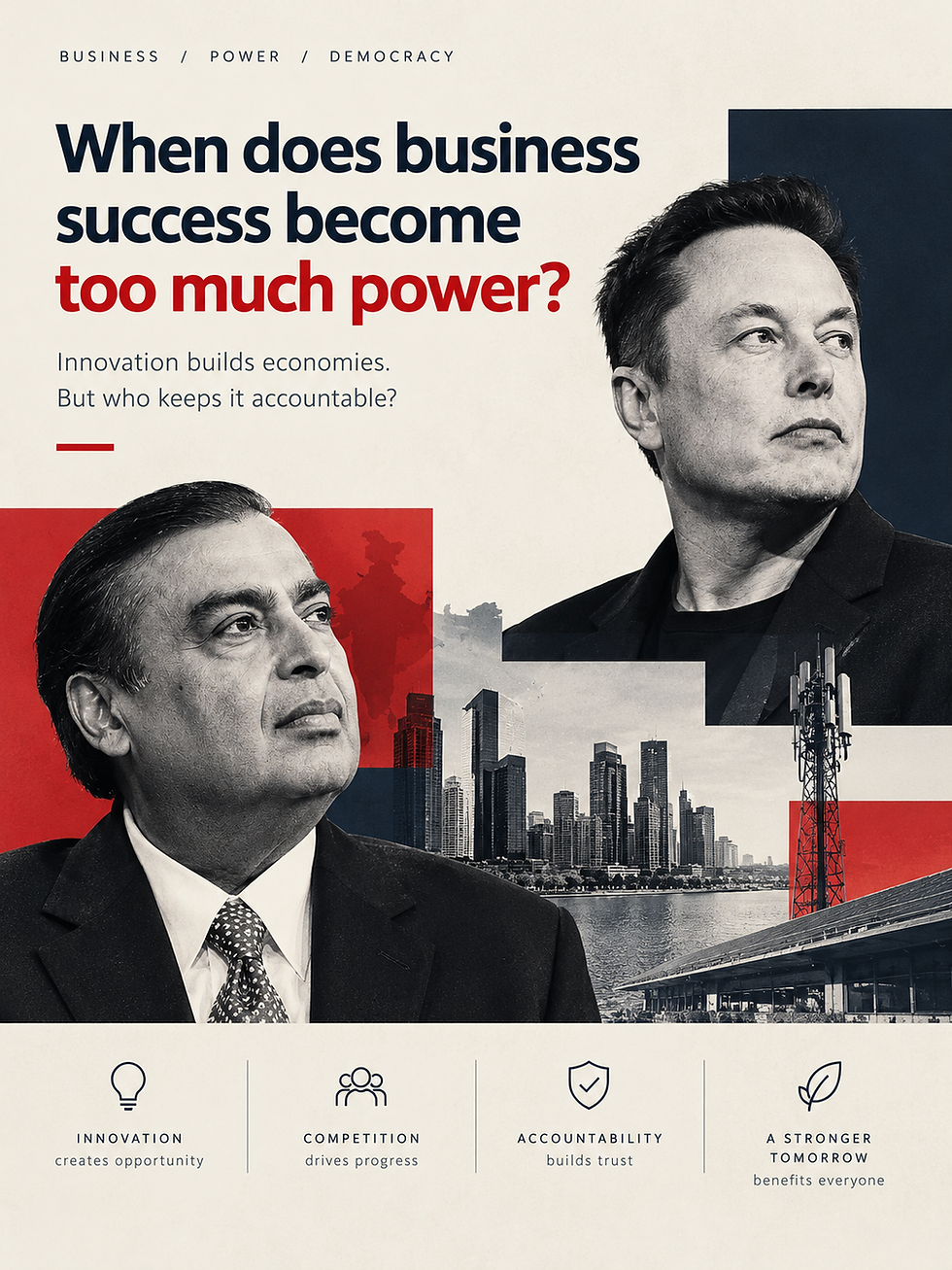
A provocative exchange involving Elon Musk and Mukesh Ambani has brought an important question into focus.
Musk questioned whether Ambani was the real boss of India. Global Times reportedly responded by turning the question around, asking whether Musk was the real boss of the United States.
The exchange is striking because it exposes a tension at the heart of modern capitalism. The world's most successful entrepreneurs can create extraordinary economic value, transform industries and accelerate technological progress. Yet the scale of their businesses can also give them influence that extends far beyond the marketplace.
The important question is not whether billionaires should exist, whether large companies should succeed or whether entrepreneurs should have a voice in public debate.
It is this: How do we ensure that private economic power remains compatible with public accountability?
For investors, founders and the wider startup ecosystem, this is a question worth examining carefully.
1. The power behind the question
To understand why the exchange matters, it helps to look beyond the personalities involved.
Mukesh Ambani leads Reliance Industries, a conglomerate with interests spanning energy, retail, telecommunications and digital services. Its businesses operate at a scale that makes them significant to India's economic and technological landscape.
Elon Musk, meanwhile, leads or holds major interests in businesses spanning electric vehicles, space technology, satellite connectivity and social media. Several of these businesses operate in sectors where government contracts, public policy, regulation and strategic infrastructure play important roles.
Their circumstances are different, and their respective countries have different political and regulatory systems. Nevertheless, both illustrate a broader reality: certain businesses can become so economically significant that decisions made by their owners have consequences extending well beyond their shareholders.
This does not mean that either individual literally governs his country. Elected institutions, courts, regulators and laws continue to matter.
However, political influence does not always require formal political office.
A business can influence the practical choices available to a government through its control of essential infrastructure, its capacity to mobilise investment, its technological capabilities or its importance to employment and economic growth.
The distinction is between holding public authority and possessing enough economic power to influence how that authority is exercised.
That distinction deserves attention, particularly when private interests and public policy intersect.
2. India, Ambani and the question of market access
The dispute surrounding Starlink's proposed expansion into India offers a useful case study.
Starlink, operated by Musk's SpaceX, provides satellite internet services. Its potential entry into India raises questions about connectivity, competition, spectrum allocation, security requirements and the relationship between satellite internet providers and established telecommunications companies.
Reliance Jio, part of the Reliance group, is a major participant in India's telecommunications market.
When Musk raised concerns about Ambani's influence, the dispute became a broader debate about whether established business interests could affect the entry of a new competitor.
However, an important distinction must be maintained. An allegation of unfair influence is not proof that such influence occurred.
India's government has pointed to regulatory and security requirements involved in the satellite internet approval process. A delayed launch does not, by itself, demonstrate that an incumbent business has obstructed a competitor.
The appropriate questions are more specific.
Are the regulatory requirements clearly defined?
Are they applied consistently across competing providers?
Are decisions explained transparently?
Can businesses challenge decisions through established procedures?
Do the rules serve legitimate public interests, or do they unnecessarily restrict competition?
These questions can be asked without presuming misconduct by any company or public official.
They also illustrate why transparent regulation matters. When governments make decisions affecting competitive markets, public confidence depends not only on the outcome but also on the fairness and consistency of the process.
For a growing economy, this is particularly important. Investment requires predictability, but predictability should come from reliable rules, not preferential treatment for established market participants.
3. Why the same scrutiny must apply to the United States
The question becomes more interesting when the focus shifts to Musk himself.
Musk's businesses operate in industries closely connected to public policy and government procurement. SpaceX, for example, has significant relationships with NASA and the US Department of Defense. Tesla's business is influenced by transport, energy and industrial policy. X gives Musk ownership of a major communications platform.
In 2025, Musk also served in a government advisory role associated with the Department of Government Efficiency, commonly known as DOGE. His simultaneous private business interests prompted concerns about conflicts of interest and the relationship between corporate influence and public administration.
These circumstances justify scrutiny of disclosure requirements, procurement safeguards and the independence of government decision-making. They do not, on their own, establish that Musk used public office to advance his personal business interests.
The underlying principle is straightforward.
When individuals with substantial commercial interests participate in government, institutions must be able to manage potential conflicts of interest credibly. Rules on disclosure, recusal, procurement and independent oversight should not depend on whether the individual is popular, politically influential or exceptionally successful.
The same principle applies to any country.
If we question the influence of a powerful businessman in India, we should be willing to examine the influence of powerful businessmen in the United States. If we expect transparent decision-making from one government, we should expect it from others.
Accountability loses its meaning when it depends on whose interests are being examined.
4. When does admiration become hero worship?
Entrepreneurship is one of the important engines of economic progress.
Building a successful business requires identifying opportunities, solving problems, allocating capital, attracting talent and delivering value to customers. Entrepreneurs who accomplish these things at scale can inspire others to create businesses of their own.
Their achievements deserve recognition.
But admiration becomes problematic when professional achievement is treated as proof of broader moral or political authority.
A successful founder may be an exceptional engineer, strategist or investor without necessarily being an expert in public policy, social welfare or democratic governance.
A profitable company may deliver excellent products while still requiring competition oversight.
A visionary leader may have valuable ideas while still being subject to the same laws and accountability standards as everyone else.
The danger begins when success becomes a substitute for scrutiny.
Hero worship can encourage people to interpret criticism as jealousy, treat commercial dominance as evidence of superior judgement or assume that a wealthy individual knows what is best for an entire society.
This is not merely a problem associated with billionaires. It is a broader tendency to confuse success in one domain with authority in every domain.
Healthy admiration recognises achievement while preserving the right to question decisions. Uncritical admiration weakens that distinction.
For founders and investors, the difference is particularly relevant. We can celebrate ambitious entrepreneurs without assuming that every decision they make serves the wider public interest.
5. Monopoly is not the only concern
Market concentration is an important part of this discussion, but the issue extends beyond whether one company has a formal monopoly.
A business can acquire significant power through network effects, economies of scale, ownership of essential infrastructure, exclusive access to resources or the high cost of switching providers.
In some circumstances, market concentration emerges because a company offers a better product or operates more efficiently. Consumers may benefit from that success.
In others, established players may have advantages that make it difficult for new entrants to compete, even when those entrants offer promising alternatives.
A further concern arises when businesses can influence the rules that determine their own competitive environment.
This is often discussed through the concept of regulatory capture, in which regulatory institutions become excessively responsive to the industries or interests they are supposed to oversee.
Regulatory capture does not necessarily require an explicit agreement or illegal conduct. It can develop through unequal access to policymakers, dependence on industry expertise, lobbying, revolving-door employment or an institutional preference for established businesses.
This makes transparent processes and independent oversight essential.
The objective should not be to punish companies simply for becoming successful. Nor should every large business be viewed with suspicion.
Instead, regulators should examine whether markets remain genuinely contestable, whether competitors have fair opportunities to enter and whether consumers retain meaningful choices.
The real test of a healthy market is not simply whether a company can win. It is whether the market remains capable of producing alternatives.
6. The hidden risk: When a country becomes dependent on a company
Perhaps the most important issue is not corporate size itself, but dependence.
Consider what happens when a government relies heavily on a private company for strategic technology, a critical communications service, major infrastructure or a capability that few other organisations can provide.
The company may be delivering enormous public value. Its expertise and investment may be difficult to replace. Its continued participation may be essential to the successful delivery of national projects.
Yet this dependence can also reduce the government's practical freedom of action.
Replacing the provider may be expensive or technically difficult. Challenging its decisions may carry significant economic costs. A sudden disruption could affect businesses, public services or national security.
Over time, a relationship that began as a productive partnership can become difficult to manage on equal terms. This does not mean governments should avoid private-sector partnerships. In many industries, collaboration between public institutions and private companies is essential to innovation and development.
The question is whether governments retain credible alternatives, sufficient technical expertise and the institutional capacity to supervise essential services.
Interoperability, contingency planning, competitive procurement and clear public-interest obligations can help preserve that capacity.
The objective is not to eliminate dependence entirely, which may be impractical in some sectors. It is to prevent dependence from becoming an unaccountable source of power.
7. What this means for founders, investors and the startup ecosystem
For an investment ecosystem such as the one BestVantage Investments works with, these questions are directly relevant.
Startups often enter markets dominated by established businesses. They need access to capital, talent, distribution, infrastructure and customers. They also need regulatory frameworks that are predictable and fair.
Large companies can be valuable participants in this ecosystem. They may provide infrastructure, acquire innovative startups, invest in emerging technologies, create partnerships and help promising businesses reach customers at scale.
Institutional investors and established businesses can therefore play an important role in accelerating entrepreneurship.
However, an ecosystem becomes less dynamic when success depends disproportionately on access to a small number of powerful gatekeepers. If market entry becomes excessively difficult, promising founders may struggle to compete. If regulatory outcomes are unpredictable, investment decisions become harder to evaluate. If a few firms control critical routes to customers or infrastructure, smaller companies may have limited bargaining power.
These are not arguments against large businesses or corporate investment.
They are reasons to support an environment in which innovation can emerge from multiple sources, capital can reach promising founders and competition remains meaningful.
For founders, the lesson is equally practical. Building a sustainable business means creating genuine value for customers, developing sound governance and competing on the strength of the business rather than relying on privileged access.
And for policymakers, the priority should be to establish conditions in which both established companies and new entrants can contribute to economic growth. A thriving startup ecosystem does not require every business to be small. It requires ambitious businesses to be able to emerge, compete and grow.
8. The safeguards that make business power accountable
The answer to concentrated economic power is not hostility towards successful entrepreneurs. It is the development of institutions capable of balancing private enterprise with the public interest.
Several principles are particularly important.
Transparent regulation: Licensing, procurement and resource allocation should follow clear, published criteria, with meaningful avenues for review.
Effective competition policy: Authorities should examine barriers to entry, anticompetitive conduct and mergers that could undermine future competition.
Conflict-of-interest safeguards: Public officials and individuals exercising government responsibilities should disclose relevant interests and follow enforceable rules designed to protect impartial decision-making.
Independent oversight: Regulators and public institutions need sufficient autonomy and expertise to scrutinise companies, including those on which governments depend.
Media pluralism: Diverse sources of information and transparency around ownership help citizens evaluate the actions of both public officials and private businesses.
Public-interest protections: Essential services and strategic infrastructure should be governed with attention to continuity, resilience, security and the availability of alternatives.
These safeguards do not prevent businesses from succeeding. They help ensure that commercial success does not become a substitute for public accountability. They also protect responsible businesses from the uncertainty and reputational damage that arise when markets are perceived to depend on personal connections rather than transparent rules.
9. A nation is not a company
There is a fundamental difference between running a business and governing a country.
A company pursues legitimate commercial objectives within the law. Its management must consider customers, employees, investors and other stakeholders.
A democratic government has a broader responsibility. It must protect rights, administer public institutions, provide public goods and balance the competing interests of society.
These responsibilities sometimes align with business interests. Profitable companies can create employment, develop technology, expand access to services and contribute to public revenue. A stable and effective government can also create the conditions in which businesses thrive.
At other times, interests diverge.
A company may prefer less competition, while consumers benefit from more. A business may seek lower costs, while public policy must account for other social priorities. An investor may focus on financial returns, while a country must also consider resilience, affordability and the distribution of economic opportunity.
These tensions are a normal part of a market economy. The role of democratic institutions is to manage them transparently and fairly.
Private enterprise should have the freedom to innovate, invest and advocate for its interests. But wealth alone should not confer a greater right to determine public priorities.
A country can benefit enormously from its most successful entrepreneurs without allowing their commercial interests to become synonymous with the national interest.
Conclusion: Success deserves admiration, but power requires accountability
The exchange between Elon Musk and the question of Mukesh Ambani's influence offers an opportunity to reflect on a broader issue facing modern economies.
The important question is not whether either businessman is literally the real boss of his country. Nor is it whether large businesses are inherently harmful.
It is whether economic power remains subject to institutions that protect competition, public accountability and the ability of citizens to shape their collective future.
Entrepreneurs should be celebrated for what they build. Investors should be recognised for the capital and expertise they contribute. Successful companies should be able to grow, innovate and compete. But their achievements should not place them beyond scrutiny, and their economic importance should not automatically entitle them to greater political authority.
For businesses, the long-term objective should be to create value that can endure within a healthy, competitive and accountable ecosystem. For governments, it should be to encourage investment while retaining the capacity to act independently in the public interest.
And for society, the distinction is worth preserving.
A successful entrepreneur can help build a nation's future. That does not mean the nation should belong to the entrepreneur.
At BestVantage Investments, we believe strong entrepreneurial ecosystems are built not only on ambition and capital, but also on trust, responsible leadership and the conditions that allow innovation to flourish.
The goal is not to make business less successful. It is to ensure that business success contributes to a future in which opportunity, competition and accountability remain meaningful for everyone.
What do you think?


Comments