
India Spacetech Startups Are Entering a Defence-Led Growth Phase
Introduction
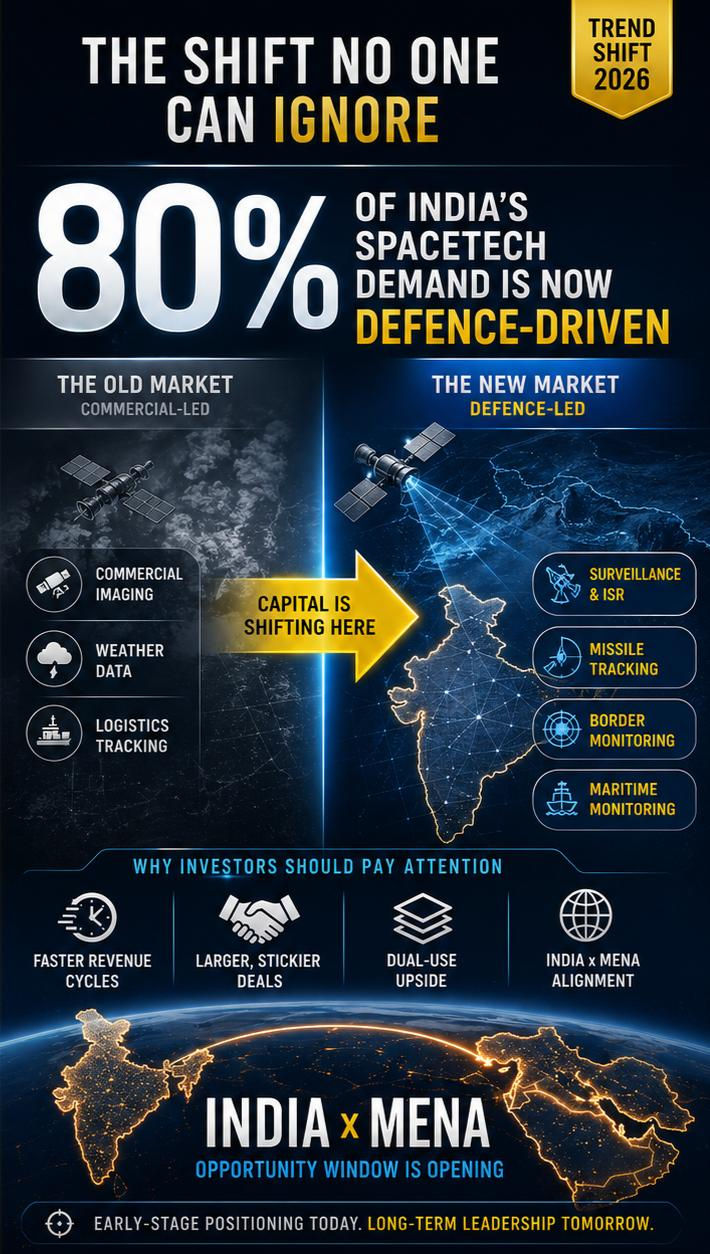
India spacetech startups are entering a new phase of growth as defence demand begins to dominate the sector. For years, India's spacetech startups focused heavily on commercial applications such as satellite imaging and weather data. However, the market dynamics for India's space tech startups are shifting rapidly.
Today, India's spacetech startups are increasingly aligning with defence spacetech requirements, creating new opportunities for investors across India and MENA.
Why India Spacetech Startups Are Moving Toward Defence
India spacetech startups are seeing a clear shift in demand patterns. Commercial adoption has historically been slow, leading to long sales cycles and limited revenue visibility. In contrast, defence spacetech offers faster procurement cycles and larger contract values.
As a result, Indian space tech startups are prioritising defence space tech applications such as surveillance, missile tracking, and border intelligence. This transition is transforming India's spacetech startups into strategic infrastructure providers rather than just commercial service companies.
Key Growth Drivers for India Spacetech Startups
Several factors are accelerating the growth of India's spacetech startups in the defence spacetech segment.
1. Faster Revenue Cycles
India's spacetech startups benefit from quicker decision-making in defence spacetech contracts. Governments act with urgency, reducing delays and improving cash flow.
2. Larger Contract Sizes
Defence spacetech deals provide Indian spacetech startups with long-term revenue visibility. These contracts are often multi-year engagements, making them more stable than commercial deals.
3. Rising Geopolitical Demand
Indian space tech startups are gaining traction as countries increase investments in defence space tech. Surveillance and intelligence capabilities are becoming essential.
Dual-Use Advantage for India Spacetech Startups
One of the biggest advantages for India's spacetech startups is the dual-use nature of their technology. While defence spacetech drives initial adoption, the same capabilities can be applied across multiple industries.
India spacetech startups are leveraging defence space tech innovations for:
● climate intelligence
● logistics optimization
● disaster response
● resource mapping
This dual-use model allows India spacetech startups to scale across both government and commercial markets.
India and MENA Opportunity for India Spacetech Startups
Indian space tech startups are well-positioned to expand into MENA markets. Governments in the region are significantly increasing investments in defence, space tech, and space infrastructure.
This creates a strong opportunity for India spacetech startups to collaborate with MENA stakeholders and establish long-term partnerships. Defence spacetech is becoming a key bridge between India and MENA in the space economy.
What Investors Should Know About India Spacetech Startups
For investors, India's spacetech startups present a unique early-stage opportunity. The shift toward defence spacetech is improving capital efficiency and reducing risk.
India's space tech startups are no longer dependent on slow-moving commercial demand. Instead, defence spacetech is providing a strong foundation for growth.
Investors who enter early into India's spacetech startups can benefit from this structural shift before the market becomes fully competitive.
Conclusion
Indian space tech startups are undergoing a major transformation driven by demand for defence space tech. This shift is not temporary. It represents a long-term structural change in how the space economy operates.
As India's spacetech startups continue to evolve, defence spacetech will remain a key growth driver. For investors in India and MENA, this is an opportunity to participate in one of the most important emerging sectors.
The question is no longer whether India's spacetech startups will grow. The real question is who will capture the opportunity early.


Comments